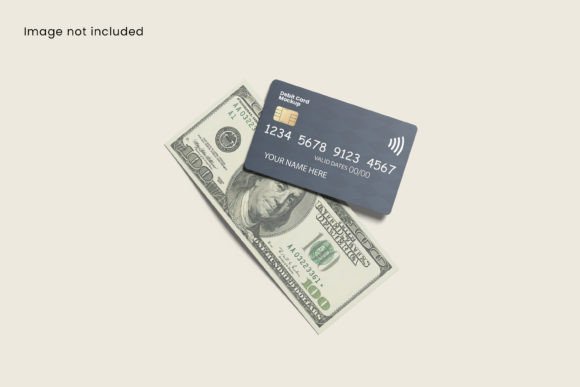
Debit Card and Money Mockup: A Practical Tool for Designers and Professionals
The Debit Card and Money Mockup is a versatile digital asset designed to help professionals, creators, and entrepreneurs showcase their designs in a realistic 3D environment. Whether you're working on branding, marketing materials, or financial product presentations, this mockup offers a streamlined way to visualize your work before finalizing it. Its integration into design workflows can significantly enhance the presentation of your ideas, making it an essential tool for those who rely on visual communication.
Understanding the Debit Card and Money Mockup
A Debit Card and Money Mockup is essentially a pre-designed template that simulates the appearance of a debit card with money elements. It allows users to insert their own designs, logos, or graphics into a realistic layout. This makes it ideal for designers who want to demonstrate how their work would look in real-world scenarios without the need for physical prototypes.
This mockup is particularly useful in the context of product development, where visual accuracy and presentation quality are crucial. It fits seamlessly into broader processes such as branding, advertising, and digital marketing, offering a professional touch to any project that involves financial instruments or payment solutions.
Use Cases and Workflow Integration
The Debit Card and Money Mockup can be used at various stages of a project. Before starting a design, it serves as a reference point to understand how the final product should appear. During the creative process, it helps in testing different layouts and visual elements. After the design is complete, it acts as a presentation tool to communicate the final output to clients, stakeholders, or team members.
For example, a designer working on a new debit card concept can use the mockup to present multiple variations to a client. By replacing the smart-object layers, they can quickly show how different color schemes, fonts, or graphics might look on the actual card. This not only saves time but also improves the decision-making process by providing a clear visual representation.
In business workflows, the Debit Card and Money Mockup can be part of a larger design library. Teams can maintain a collection of mockups and templates, ensuring consistency across all visual assets. This approach supports efficient collaboration and reduces the risk of design inconsistencies.
Key Features and Benefits
The Debit Card and Money Mockup comes with several features that make it a valuable addition to any designer’s toolkit. One of the most notable features is the ability to change the background color. This flexibility allows users to match the mockup with their brand identity or specific project requirements.
The dimensions of the mockup—3000x2000 pixels at 300 dpi—ensure high-quality output suitable for both digital and print media. This resolution maintains clarity and detail, making it ideal for professional presentations and marketing materials.
Another key benefit is the use of smart-object features in Photoshop. These allow users to replace existing designs with their own in seconds, eliminating the need for complex editing. The included PDF help guide further simplifies the process, making it accessible even to those with limited design experience.
It's important to note that while the mockup includes sample images for illustration, these are not part of the downloadable file. Users should ensure they have the necessary assets ready before using the template.
Practical Implementation Tips
To get the most out of the Debit Card and Money Mockup, consider the following tips:
- Prepare Your Assets: Before opening the mockup, gather all the design elements you plan to use. This includes logos, text, and graphics. Having everything ready will streamline the process and reduce delays.
- Use Smart-Objects Effectively: Take full advantage of the smart-object layers to replace designs quickly. This feature ensures that your changes are non-destructive and easy to adjust later.
- Customize the Background: Adjust the background color to align with your brand or project theme. This small detail can greatly enhance the overall professionalism of your presentation.
- Test Different Layouts: Experiment with various design configurations to find the most effective layout. The mockup allows for quick iterations, helping you refine your design before finalizing it.
- Keep a Consistent Style: Maintain a cohesive visual style across all mockups and templates you use. This consistency reinforces your brand identity and improves the overall user experience.
Integration with Other Tools and Resources
The Debit Card and Money Mockup works well with other design tools and resources. For instance, it can be used alongside graphic design software like Adobe Illustrator or InDesign to create comprehensive visual packages. It also integrates smoothly with project management platforms, allowing teams to share and review designs efficiently.
Additionally, the mockup can be paired with other mockup templates to create a more extensive portfolio. This approach helps in demonstrating a wide range of design capabilities and strengthens the overall presentation of your work.
When working with clients or stakeholders, the Debit Card and Money Mockup can serve as a conversation starter. It provides a tangible representation of your ideas, making it easier to discuss feedback and make necessary adjustments.
Long-Term Use and Maintenance
For long-term use, it's advisable to keep a backup of the original mockup files. This ensures that you can always return to the base template if needed. Regularly updating your design assets and keeping the mockup organized within your workflow can also improve efficiency over time.
As your design needs evolve, consider expanding your collection of mockups and templates. This practice not only enhances your creative flexibility but also supports scalability in your projects.
The Debit Card and Money Mockup is more than just a design tool; it's a practical solution for professionals looking to enhance their visual communication. By integrating it into your workflow, you can improve the quality of your presentations, streamline your design process, and deliver more impactful results.